Showing posts with label movies. Show all posts

Friday, June 10, 2011

The Lawsuit Locker

Copyright is a complicated issue, and I often find myself conflicted about it.

On the one hand, as a former movie theatre manager, I totally get the conservative argument that films cost a lot of money to produce, and that piracy threatens to reduce the incentive for studios and theaters.   Since I like to watch movies (and listen to music, and play games, and read books, and etc), I spend money on them.

On the other hand, as a fan of sci-fi, I dream of a utopian golden era where civilization is enriched by the free sharing of ideas. And I look at the technology we have, and realize that optimistic dream could be true today if not for stodgy rich people desperately clutching at all the money they can grab.

In general, this results in me supporting independent productions and alternative distribution channels as much as I can. Put the money in the hands of the artists, and not in the hands of some corporate suit. I buy direct from the artists, jump on the Humble Indy Bundle bandwagon, etc.

When I read articles like this one at CNN, I find whatever little sympathy I might have had for the rich bastards and their incentive system just boils away:
Voltage Pictures, the studio behind 2009's The Hurt Locker, is suing almost 25,000 BitTorrent users who allegedly illegally downloaded the flick. That came just weeks after 23,000 were sued for downloading The Expendables, produced by Nu Image.
 ...
"The lawyers are just doing their jobs," he said. "Somebody stole our property and we are trying to get it back." The representative declined further comment. 
That statement from a Voltage representative is just a little bit misleading, methinks. What exactly is the stolen property that they are trying to get back? It's certainly not the physical copies of the films in question. No one is deprived of watching, enjoying, or collecting these films legally because they've been "stolen" by someone else. There's no empty vault or warehouse at Voltage, no one who came home to find that his shelves were ransacked by a burglar (at least not in this court case). What's been "stolen"? What does this executive at Voltage think he owns, that has been wrongly taken from him?

Sadly, what he thinks he owns is the money in other people's wallets. Money he himself has never held, but which he has convinced himself somehow belongs to him. You not buying from him = you stealing from him (in his mind). He's somehow certain that you would have spent that money with his company, and since he believes that to be true, he's decided to take you to court over it. That seems pretty fucking presumptive to me.

He's assuming that instead of passing on his movie, if you couldn't download it for free you automatically would have bought it. That instead of buying it at the thrift store, or borrowing it from a friend, or paying 99 cents to rent it somewhere, you would have, in his mind, spent $25 for the Blue-Ray version at some store. The store takes a cut, the supply network takes a cut, and maybe if he's really lucky, his company pockets $12 on the sale. Of course realistically those 25,000 "thieves" would have included at least 15,000 (and probably a lot more) who passed, borrowed, rented, bought it on deep discount, etc, so at the very most one could maybe argue that each of those downloaders "owes" him $5. And honestly, that figure seems wildly generous and optimistic to me.

So how much is his company asking for? Tens of thousands of dollars per person. Talk about punitive damages! But he'll settle for a quick two grand if you want to roll over out of court. What a dick. It seems to me that this is not about protecting their property, or their rights, it's about making a quick buck.
As TorrentFreak, the first blog to report on the Locker case, points out: If only 10,000 of the alleged infringers pay a $2,000 settlement, it would net $20 million for Voltage and USCG. In comparison, The Hurt Locker grossed $17 million at the U.S. box office.

Monday, May 9, 2011

Netflix Jumps The Shark

So I'm at the Thrift Store the other day, and they have the second season of Alias on DVD. It's at a good price, but not a great price. Off the top of my head, I couldn't recall if I liked the second season. I remember the first season was brilliant, and the third season was painfully bad. But I couldn't remember when it started getting stupid. Rather than risk throwing money away on something I might regret buying, I decide to check my netflix ratings for the second season when I get home, and should it prove to be a worthy season, I'll swing back and pick it up.

Get home, log in to netflix, and attempt to look it up. I expected to see the five seasons rated individually. Instead, to my surprise and horror, they've consolidated all five seasons into one entry. They applied my rating from the first season to all that followed. I'm 100% certain I gave Season 3 a single miserable star, but now it's merged with Seasons 1, 2, 4 and 5, and the whole lot are rated with five stars. A quick glance about the site shows me that they've done similar mergings for nearly all TV series.

Honestly, I've been hoping that someday Netflix would allow further differentiation of ratings within a series, and instead they've reduced it. I've repeatedly wished over the years that they'd allow me to rate per disc or per episode of a show, and not have to generalize about entire seasons at once. Then when a new disk shows up, you could skip the episodes that all of fandom gave a one star rating. Just imagine how cool it would be to look at a list of all theTrek episodes, and be able to separate the dozen groundbreaking and mindbending sci-fi classics from the crappy Romulan Yahr invasion plotlines and the hundreds of mindless holodeck episodes just by how many stars the public gave each individual episode. That would be sweet... and so very very useful.

Instead, they've pushed the other way, making us give a single rating to an entire series. Given that the "jump the shark" phenomenon is so pervasive in series programming that there's even a catchy turn of phrase to describe it, it seems ridiculous that netflix would pretend it doesn't happen. Of all the series I've ever watched from beginning to end, only a precious handful didn't suffer from some sort of dip in quality after a certain point.

How could this simple truth escape Netflix, a company whose entire focus is on not just renting films but on compiling your ratings of them and using those ratings to suggest what other films you'll like. And they take the same amount of money from you regardless of how many films you watch in a month, so there's no conflicting financial incentive for them to make you watch crap. Giving you good recommendations and good customer service is in their obvious best interests. Failing to warn you that your new favorite show turns to crap after the star leaves in season four does them no good. What are they thinking?

Now I have to redo all my TV series ratings.  Shall I rate Alias based on the taut and byzantine first season, the painfully predictable third season, or the regurgitated fifth? How do I reflect that The IT Crowd starts dry and slow for its first 5 or 6 episodes, but is worth muddling through for the incapacitatingly funny second season?  Is there a way to note that LOST season 5 ends with one of the crowning moments of awesome in TV history, but season 6 ends with a let-down? How do you draw the hard lines where Ritchie Cunningham joins the army, the Great Gazoo lands in Bedrock, or when Sherman T. Potter replaces Henry Blake? More importantly, how can I trust a Netflix rating on a TV show ever again? Every series is now a potential mine field.

I'm a little annoyed at this, so I decided to send them a complaint email. Maybe it wasn't too late to reverse this change.  I knew it would be hard to rally the Netflix fan base this time, because there's no longer any sort of netflix community. They eliminated all the social networking tools from the site a few years back, so you can't readily contact other netflix customers. I have no delusions about being a great leader or organizer, so I figured if I could at least send an email complaint to netflix itself, I'd be doing my part.

Complain once, and move on.  Such complaints could actually work if enough people took part, because such complaints worked last time.

That was a couple years back, when they almost eliminated the "profiles" feature. The profiles function is what allows you to maintain multiple queues on one account, useful if the various members of your household have different tastes. They tried then to merge all the profiles into the main accounts, but backed off from it when the customer base rose up in complaint against the notion. Nobody wanted to have to re-rate hundreds of films, or have their account suddenly start recommending for the whole household a muddied mix of slasher films and Dora the Explorer.

So, I'd just drop a quick email and...

You ever try to email Netflix? It's impossible. Not just a little tricky, but completely impossible. It's amazing that a so thoroughly online company can have completely forsaken email and text-based communication. As it turns out, ever since shortly after the whole "profiles" rebellion, they've eliminated all incoming public email addresses. They replaced them with a 24-hour phone center. Which would be okay, I guess, if I didn't have spasmodic dysphonia and a pay-by-the-minute cellphone plan. So I searched a little online, because I figured they probably at least needed an email address for deaf people to contact them. As it turns out, no, the deaf community is up in arms about Netflix eliminating email, not training call center staff on how to take relay calls, and even not putting captions on most streaming content (including most films that have captions on the DVD).

What was I just saying about "good customer service" being "in their obvious best interests"? Netflix clearly doesn't agree.

Wednesday, December 8, 2010

Prison Comparisons

Because, lately,  movies and TV seem more plausible than the events of the real world...

Prisons in Sweden, according to The Girl With The Dragon Tattoo trilogy: You're kept in a small room, but otherwise it's a cake walk. You get reading material, and can access your laptop. You get to wear whatever you like, even if that involves about 18 different piercings and your hair up in a 'hawk. You don't have a cell-mate.

Prisons in London, according to The Tutors: What's that moving under the pile of straw I've got for a bed? Big freakin' rats. This place will drive you insane.

Prisons in the US, according to... just about every prison-based movie or TV show ever made: The guards and crooked sheriff or warden beat you up, and the prisoners rape you. You're sprayed down with a hose, and they routinely search you for anything contraband, except for cigarettes. Your nazi cellmate tattoos a swastika on your ass. Then one day you get shivved, and die.

Given the alternatives, I can only assume that Julian Assange really doesn't like Pickled Herring.

Friday, September 10, 2010

Bad American Remakes

Someone here pointed out a fantastic Scandinavian film and went into detail about how Hollywood would fuck it up. I watched the Girl With the Dragon Tattoo. It was incredible. (The YouTube trailer is crap.)

Another good recent Scandinavian film was Let the Right One In. For those who have seen it, prepare to be mortified by the Hollywood remake.


From what I see in this trailer, me thinks Mr. Bergstrom's prophecy of what a bad US version might look like may have been a bit conservative. Let's hope they leave that one alone.

Thursday, July 22, 2010

Inglorious Plummers

Cross-posted because this video made me laugh:


EDIT: Hmmm... video seems to not work from time to time. Should that be the case when you try to view it: It's basically the trailer for Inglorious Basterds, but with various Mario characters instead of Brad Pitt & company.

Wednesday, June 30, 2010

The Girl With The Dragon Tattoo

Yesterday my wife and I went to see an awesome Swedish film, that will no doubt soon be remade into a crappy American version.

When that happens they'll cast the male lead 10 years younger, and give him all the good lines. The female lead will be 3 cup sizes larger, have at least 5 fewer piercings, and be reduced to nothing more than the plucky sidekick. There will be less nudity overall, but more sexual tension. The attention paid to technical details and getting the computer stuff right will instead be hand-waved into the "magic enhancement filters" of CSI. The American version will probably start with some gory prologue that totally spoils the impact of later developments, and sure-as-hell won't open with a grown man crying over pressed flowers. The Nazis will be cartoony mooks instead of creepy millionaires, as no one will expect US audiences to understand references to the Winter War and all the complicated political turmoil that the Scandinavian countries went through during WW2. The torture sequences, however, will be retained, and they'll probably add a completely unnecessary prison-rape sequence since American jails are much harder than the ones in Sweden. The amount of violence will go up, but the impact of it will go down, resulting in a less shocking film overall.

Go see it now, while it's still a refreshingly unique film with a decidely European perspective and a powerful female lead unlike anyone you've seen on our screen. 'Cause when that US version comes out, it's probably going to be boiled down and watered down to CSI vs Nazis, and everything good will be lost in translation.

Friday, April 9, 2010

Clash of the Plot Holes

If Peter Jackson had attention-deficit disorder, and was doing a lot of meth while making the Lord of the Rings films, we now know what the results would have been like. They would have been just like the new remake of Clash of the Titans.

It's kinda pretty at times, but that's the most I can say for it. It's not so much exciting as it is spastic. Within this film, things happen for arbitrary and senseless reasons, and they do so as quickly as possible. Most of the fight scenes are the action-movie equivalent of a Jackson Pollock painting. It may be pretty, and it sure has a lot going on - but what looks from a distance to be detail, on closer examination turns out to just be random splatters without meaning.

"Let's put Treebeard in the desert! Then we'll have him ride around on the back of one of those giant elephants. When he gets off the elephant, he'll do some kung-fu, then we'll wrap a giant snake around him, and then he'll explode!" It's like that, except the giant elephant has been replaced by a Scorpion of variable size, and Treebeard is wearing Iron Man's neon-blue heart implant. Don't ask me why, none of it made any sense. I still can't figure out why the freaking Ents were even in Clash of the Titans. They're not in the 1980's version, and they're not in Greek myth either, and their inclusion is completely random - but the same thing can be said about almost every element of this movie.


The film is really shallow, too, and it features characters we neither care about, nor believe in. At no point during the film did I want Perseus to succeed at his stated goal, but neither did I particularly want him to fail. Most of the time, I just didn't care. It's not like he was fighting against a villain. The film pointedly has no villains. I mean, there's Calibos, he seems pretty bad, but when you think about it, he's just angry because Zeus raped his wife and Hades took advantage of him. His actions are deplorable, but his motivations are basically the same as the Hero - he's rebelling against that bastard Zeus. But Zeus isn't the bad guy either, as the film ham-handedly reminds us during its hard-to-swallow happy ending. So that must mean Hades is the villain, except the film points out to us again and again that Hades is only so bitter and manipulative because Zeus tricked and betrayed him.

I'm a big fan of "shades of gray"-style moral ambiguity in a film, but in the Clash remake, this is done really sloppily and never fully explored. We're never torn over what is the right thing to do, and neither are any of the characters. Instead, we're just given mixed messages about who really is the monster, and then quickly distracted from contemplating any of it by yet another incomprehensible action sequence. Hey look - a harpy! WTF?


In this film, the main character, Perseus, has 3 fathers:
  • There's the mortal fisherman who raised him as his own. Shortly before he dies, he tells Perseus that what he really wants his son to do is to stand against the Gods, and change the world so that mankind will no longer be enslaved by Olympus. Perseus starts off to fulfill his father's last wish, and then kind of abandons that goal without ever saying why.
  • There's Zeus, king of the Gods, who raped Perseus's mother, and then abandoned the resulting child. But he's not the bad guy, we are told again and again. After 20 years of being a dead-beat dad, he's now trying to make up for it. His wish is for Perseus to take his rightful place in Olympus, but Perseus declines that opportunity both times it's offered to him.
  • His third father is the asshole who killed his mother and tried drowning him as a child. Later, he turns into a real (as opposed to just figurative) monster, and tries to slay the adult Perseus. Obviously, that won't do, so he's killed by his step-son Perseus. His dying wish is, strangely enough, for Perseus to not become a God, and stay away from Olympus. It's delivered very oddly, practically "I know I've been trying to kill you, but it's for your own good. Please don't become a God, because that'd be really bad for you, and I'm worried about your future and the fate of humanity." It's a really lame attempt at a Darth Vader redemption, made all the weaker by the fact that the director doesn't feel compelled to give it more than 3 seconds of screen time.
So, of course, the mutated, mother-killing, trailer-trash monster of a father gets his dying wish fulfilled by Perseus. The film tries hard not to draw attention to this fact, though, and instead just sweeps it under the rug. It's like they're playing thesis-statement roulette, with a new winner every five minutes.


The worst part of the film, however, is the hackneyed attempt at foreshadowing that then gets abandoned and forgotten at the end, ret-conning itself into a red herring. I'm talking about the warning of the Stygian Witches. They go to see the witches, these three inhuman blind seers of great wisdom and insight. On the way there, Io (Perseus's shallow and unbelievable love interest) spends several minutes ominously warning Perseus not to ask any more questions of the witches beyond the obvious "how to kill the Kraken" question. She says he won't like the answer he gets, and it's really played up as a big deal, like there's something nasty in his destiny.

Sure enough, the witches drop a doozy on him. They prophecy that he's going to die while fighting the Kraken. The music swells dramatically, and Io says something like "Oh, Perseus! I told you not to ask them anything else! This is so tragic!"

Then the end of the movie rolls around, and he doesn't die. In fact, he's never even wounded, and you don't feel he's actually in a lot of peril. Apparently, the all-knowing magically gifted witches were just screwin' with him, not actually foretelling the future. Despite the prophesy scene having be played up like it was a really important plot point, there's no mention of it at the end of the film, it too is just swept under the rug.

Now, it's possible that the film is just being unexpectedly subtle at the end. I doubt it, because everything has been in-your-face and beat-over-your-head before that point, but there's a remote chance it was actually a clever ending that was just so subtle it failed. Because, frankly, the last 5 minutes of the film would make a lot more sense if it were actually a far-subtler version of the end of Brazil (or the recent movie Repo-Men). Here's what I mean:

Maybe, just maybe, the Kraken actually kills Perseus. At the very end, he dives into the water in a harbor to save some girl that's almost certainly dead. After expressing her willingness to be a human sacrifice, she's fallen hundreds of feet into the water, and 80 tons of rock is falling on her. The harbor is between two steep cliffs, with a city built into them. The scenery and location were a prominent part of the scene.

He and the girl are next seen on a flat and featureless beach, and rescue ships are on the horizon coming to take the girl home. Maybe Perseus rescued her, swam several miles away to some nearby island, and somehow signaled the survivors in the devastated city that they needed a rescue. That seems to be what the film is saying. But I suppose it's also possible that he and the girl both died, and the featureless beach is Elysium / Heaven / etc. If that's what the movie was trying to convey, it did a piss poor job of saying it, but I can't completely rule it out. At least it would have made a lot more sense than the happy ending they seem to be trying to shove down our throats.


I could go on like this for a few pages more, there's just so much wrong with film. Io's supposed backstory didn't match her on-screen powers. Hades' make-up was inconsistent and laughable. The CGI critters kept changing size relative to humans. The Kraken came from Cloverfield. Etc.

I suppose maybe I should have put some spoiler warnings at the top of this post... but I think if I just "ruined" the movie for you, I was probably doing you a favor.

Wednesday, February 24, 2010

A few thoughts on Avatar

I'd just like to say:
  1. I really enjoyed Avatar. It's really polished and honed, and Cameron definitely knows how to tell a story. He's in full control of not just your senses, but your emotions, from start to finish. I'm not saying the film doesn't have a few flaws, but none of them were gamebreakers for me.

  2. Like Beowulf, it's a relatively simple plot, with lots of action and eye-candy. It's fun. I definitely think there's room for these classic timeless archetype plots, jazzed up with modern movie-making tech. The plot is a little predictable, but that's because he's using archetypes that have been steeping in the collective consciousness for hundreds of years.

  3. Reviews that focus on how the allegory or metaphor is "too simple", are missing an important point: There is no allegory or metaphor involved, and that's not a bad thing.

    We don't say Platoon or Band of Brothers had too obvious of a metaphor, because they're just telling it like it was. The only metaphorical element of Avatar is that it's set on another planet. It's just an extrapolation of what would happen should we voyage to a planet with resources we can exploit, and a primitive culture standing in the way. It's happened all through history, and it's still happening today in the third world. It's a historical film, but set in the future: "Telling it like it will be", but with glow-in-the-dark dinosaurs in the background. You can call that metaphor if you like, but I think you're missing the point.

  4. The pro-environmental, pro-indigenous-rights, anti-colonial politics of the film are a little heavy, but they're also a large portion of what I like about the movie. Had the film somehow avoided the "tree-hugging" leftist politics, it would have been just another boring Hollywood blockbuster. Instead, it has soul and a message.

    (The "other side" dispenses propaganda without a conscience every day in all our media, so it's damn hypocritical that they cry foul when the Left manages to slip it into a mainstream movie. The Right knows the Left is sensitive and defensive about things like this, so they harp on it to get the progressives to give up ground. And, sadly, it almost always works.)

  5. I really like how the film has two very strong female characters, and they're nothing alike. Most action films make female characters cardboard thin, as if the only character trait they need is "she's the chick". In Avatar, one's a pacifist, a rational scientist, and a control freak. The other is a huntress and a mystic, fierce yet compassionate and intuitive.

    (Compare this to Cameron's earlier work, Aliens, which also had two strong female characters. In that film, one's defining characteristic was "she's a mother" and the other's defining trait was "she's not a chick". That too was better than average, but he's definitely grown as a story-teller and character-writer since then.)

  6. I don't think being in 3-D was the least bit helpful, just distracting and gimmicky. Plus, the glasses pinched my face. I'll happily pick up the 2-D version on DVD.

  7. I don't believe in post-Avatar depression. I think it's just very clever viral marketing.

Monday, February 22, 2010

W(isolea)TF?

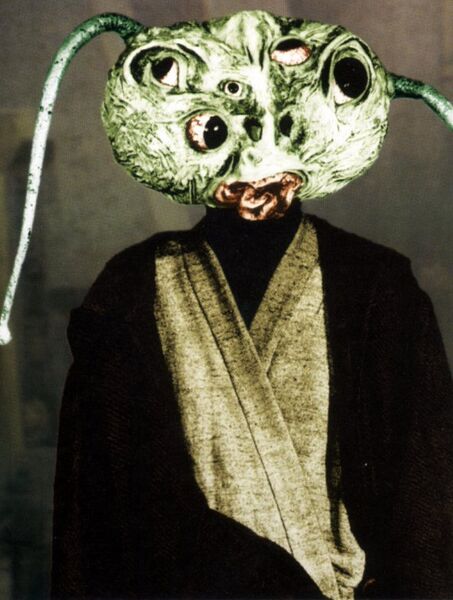
I was in a department store the other day, and I took a moment to wander through their toy section. There's this big display of Star Wars action figures. Including a figure Wisolea, who looks like this:

The action figure looked a little less ridiculous than that photo - but not much. You got this bizarre alien head with eyes all over the place, and these two long limp tentacles that just hang there - atop a perfectly human-looking body.

I had to gawk. I flip over the back of the package, to find out what part of the "expanded universe" this awful monstrosity came from.

It tells me this character is from Episode IV? Supposedly it's the merchant that bought Luke's Landspeeder for 2,000 credits.

I couldn't completely believe that. I don't remember seeing it on film, and the only image of the thing I can find online is clearly a bad pre-photoshop paste job. Someone took a colorized poster featuring b-movie horror monster, and just glued it over Obi-Wan's face. It's an illustrated head on a photographed body!

But it gets worse. The box claimed (and Wookiepedia confirms) that the critter only paid the 2000 credits it did because Obi-Wan used a Jedi Mind Trick on it to fool it into paying more than the speeder was worth.

God dammit, George Lucas! What the hell is wrong with you (and your merchandising Empire)? When Qui-Gon abuses the force to fleece Watto, the viewer can almost justify that, seeing as how Watto is a low-life and a slave-owner. Almost justified. At least the scene is kinda funny. It's still sad to see a Jedi behaving like a con-man, but it's not like anyone with any taste or intelligence considers Phantom Menace to be cannonical. We all just kinda try to pretend it doesn't exist. It communicates volumes about Lucas's takes on philosophy, morality, personal profit, and storytelling.

But, dammit, to retcon this sort of crap into one of the films that we all still love and adore? I'm insulted. Worse, Luke complains in A New Hope about how he didn't get much for his Landspeeder, that they weren't in demand since the new model came out. I get that Luke's whinny, but seriously, this retcon means he's bitching even though Obi-Wan just swindled the vendor to get that money. It's not like Luke could miss that, since in the previous scene, Obi-Wan, sitting in the Landspeeder, had done the "these aren't the droids you're looking for" trick, and explained how it worked to Luke. You've just retroactively made Luke stupid.

Thanks a lot, Lucas. I really needed you to piss all over my childhood yet again, and you and your money-machine were all too happy to oblige me.

Friday, September 11, 2009

How To Tell An Inglourious War Story (updated and expanded)

When I posted this the other day, it had been three little paragraphs. I don't think that did the film justice, nor was it terribly helpful to someone trying to decide if they should see the movie. So, here's a much longer version...


It has been a long time since a film has made me so uncomfortable, and yet simultaneously so awe-struck and impressed... in fact the only thing comparable was the first time I saw Eraserhead. Unlike Tarantino's other work, Basterds is not a "fun" movie - or not as fun, anyway - and it makes Kill Bill look family-friendly. I squirmed, I felt ill, I laughed at things I really shouldn't have, and I'm almost ashamed to admit I enjoyed it. At the same time, it was genius. I'm glad he had the courage to make it, and I'm glad I saw it in the theatre without anyone spoiling it. Well worth watching, provided you like it when films challenge you. This one will.

It's not, as Lt Raines claims it is, his masterpiece. IMHO, it may even be his weakest work, the only film of his that I don't feel the need to own. Then again, liking his films more with every viewing is par for the course - and it's not the first Tarantino film that seemed shocking on first viewing, either. It's also a film that's guaranteed to be viewed entirely differently on second watching.

Comparing it to work by other artists... I didn't really care for The Good, The Bad and the Ugly, but I love Going After Cacciato , so perhaps it makes sense that I'm so conflicted over this.

Like Cacciato, (and Cacciato's sister-short-story, How To Tell A True War Story), you know this tale is fictional, fantastically so, yet it really catches a truthful and accurate feel of the special kind of hell that is war. Depictions of the reality of war are rare in cinema - war's ugly, not heroic, and films avoid that reality. Even films that attempt to do justice to that concept (Saving Private Ryan, for example), tend to fall prey to overblown notions of heroism and morality, both of which are frequently absent in a war zone. In Basterds, you see good men doing very bad things, and sometimes you even see very bad men doing good things. You also see crazy coincidences that are completely unbelievable, yet are exactly like the type of crazy coincidences that actually happen in the real world, especially in the haze of combat. The events in this film didn't happen, but could have. In this way it's unlike most war movies, which didn't happen, and are far too sanitary to have ever happened, either.

Like Good/Bad/Ugly, the film has plenty of slow artful simmer, juxtaposed close-ups and long shots, and strong musical choices. Basterds really is a Sergio Leone Western in WWII clothing - it uses the same tropes, but with Nazis instead of cowboy bandits. As in Leone's "man with no name" trilogy, there's extremely few characters you can actually like. They're basterds, every one of them.

Watching this film was delicious agony. Any Tarantino film is going to have a few things that make you uncomfortable. His films are packed with violence and tasteless racial epithets. It's only logical that's going to get more pronounced in a film with Nazis - they are genocidal racists, after all, an army of repugnant butchers, the ultimate villains.

In Reservoir Dogs, a man is tortured. But he's at least tortured by a "bad guy". You feel disgust and outrage, even while you're bopping along to Stuck In The Middle With You. You enjoy the scene, but despise the character at the heart of it. That was hard to swallow the first time I saw it. Inglourious Basterds is like that scene, blown up into a whole movie, and then it goes a step further...

Here, the "heroes" are torturers. Nazis are the ultimate villains, and it always feels good to see them get their comeuppance, or at least it always has in the past. Here they die in some ugly, brutal ways, at the hands of the heroes. If this film had come out 10 years ago, when torture was an abstract fantasy element that only happens in movies, I don't think I'd feel so conflicted. Post Abu Ghraib, it's just not acceptable to me for the hero to torture anyone - not even Nazis.

At the same time, this is a much healthier and more honest way of examining WWII than, say, what happens in an Indiana Jones film. In a Jones movie, the Nazis are bad just because of the uniform. We never really see the rank and file being villains, and the death of each human being in that uniform has no emotional weight. We can cheer as they die, without ever stopping to consider that a _human_ just died. In Basterds, on the other hand, the Nazis do really evil things. While the madness and villainy of their leadership is center stage, the complicity of the common man is starkly depicted as well. We can't deny they deserve what happens to them. They really got it coming, and we want them to be punished. At the same time, we get to see that they are most definitely human - they have lives beyond their uniforms, and some at least have a few redeeming qualities. Which demands the question - do we really want to see them get their comeuppance in such a brutal and ferociously honest way? The conclusion I came to by film's end was not just "yes", but "Hell, Yes!" - and that unsettles me.

And, if anything, recent history has shown us that, given official sanction to do so, otherwise good men will turn into monsters for their countries. So, distasteful as those elements of Basterds are, they are completely believable. As honest and truthful as they are gratuitous.

Lastly, it's worth mentioning that Inglourious Basterds has some classic Tarantino fun as well - references to various films, campy moments, post-modern flourishes, on-screen chapter titles, etc. - but to a slightly lesser degree than in Kill Bill. Time is also handled far more linearly in Basterds than in any other Tarantino-directed film. All of this may, possibly, be a contributing factor in my not liking it as much. In Kill Bill, the flourishes were more numerous, and emphasized the theme of the film. In Pulp Fiction, they were more subtle. In Basterds, they seemed less organic than either of those, and stand in contrast to the primary theme. If he'd just stuck to Western and War Movie iconography, and down-played the post-modern campiness, it _may_ have been a more cohesive film.

Even with these caveats and complaints, I'd still give Inglourious Basterds 4 out of 5 stars. It was less comfortable than his other work, but no less artistic. He took big risks in this artwork, most of which really paid off, and a few that didn't. I am impressed by the effort and intent.

Monday, July 20, 2009

Time Travel Degrades Audio

I've come to the inescapable conclusion that traveling through time in any manner other than our pedestrian "carried downstream by the current" method has some form of damaging impact on audio transmissions.

To illustrate, I'll discuss the three* best** Time Travel movies I've ever seen.***
  • Primer. The best damn time-travel movie of them all, assuming you're not so ADD that you can't sit through a film without explosions. It's got a totally fresh take on time travel, and manages an amazing amount of complexity and internal consistency, both despite a tiny little budget. The size of the budget, however, manifests in the terrible sound channel in the first scene. The first of the five times I watched the film, I had to rewind the opening sequence again and again testing if my speakers needed replacing.
  • Time Crimes. Another incredible little film, with a great plot and oodles of self-consistency. Like Primer, it totally sells you on the idea that this time-travel could actually happen, and this is what it would be like. It's a tiny bit less logical than Primer, but makes up for it with creepiness and car crashes. However, the original language is Spanish, and the English dub that the DVD defaults too is terribly grating ADR in a echo-chamber. Great film, but only if you speak Spanish or don't mind reading subtitles.
  • Twelve Monkeys. Okay, it's a much larger budget, and thus doesn't have weird audio problems. But the guys teeth talk to him, and I think that supports my thesis.


*: If I were to extend the above list beyond the top 3 time travel films, the next slots would be filled by Blink (which is actually just an episode of Doctor Who), Memento (which actually has nothing to do with Time Travel), both Bill & Ted films (which are parodies), in that order. Time After Time, The Lake House, the original Back To The Future, and three of the four Terminator films are also worth watching, in no particular order. Beyond that list, you're better off doing just about anything else.

**: As far as I'm concerned, the most important element of any time-travel story is the sensibility of the plotline. You have to believe that the characters (unless they are supposed to be screwballs, like Bill & Ted) actually understand the ramifications of being able to travel in time. In other words, the stupidity of "San Dimas Time" only works if you're telling a comedy - it's a dealbreaker if it shows up in serious Time Travel fiction. I can suspend my disbelief of "You invented a time machine", but I can't suspend my disbelief of "You're supposedly smart enough to invent a time machine, but you're too dumb to figure out the most rudimentary uses of the damn thing." This is of primary importance to Time Travel, and it greatly exceeds all other concerns of plot, story, directing, acting, characterization, etc. Even the rule of cool must take a back seat to this principle. In an action film, I can believe there's moments where you're acting faster than you can think. In sci-fi, I can accept that the interaction between species that evolved on different planets may be unpredictably volatile. Most of the time in most films I can accept that the main characters will make really stupid decisions in regards to thier lovelifes, but it'll somehow all work out in the end (just please put something else into the storyline while you're at it). I just can't accept that someone could invent a time machine, or get promoted to the Time Police, without understanding the implications of the technology. It's like being an auto-mechanic or a professional race-car driver - but not knowing how to use little things like the steering wheel, brakes, or seat belt.

***: I'd prefer to share with you anecdotes from my own Time Travel experiences, but I'm afraid that Further Information Is Not Available Here. The Continuum doesn't like me spoiling secrets Aquarian or Pre-Piscene.

Tuesday, June 2, 2009

Indecent -quel

So you don't think I've completely turned into a gushing fanboy without the ability to discern good from drek, I'll mention that I also recently rented the Underworld Prequel, and found it to be painfully boring.

I liked the first Underworld. It had some plot holes, but it was fun and edgy. It was a triumph of style over substance, even if it was all stolen from Nancy Collins and White Wolf.

The sequel, Underworld Evolution, wasn't as good, and magnified the issues with the already muddied timeline and metaphysics of the original film. But it was still fun, even if it didn't make any sense.

The prequel, Underworld: Rise of the Lycans was was gratuitous, and not in the good way. Gratuitous in the sense of "not called for by the circumstances." There was no point to making this film. No story worth telling. Just a lame excuse to grab a few bucks. About the only thing good I can say about Rise of the Lycans is that it had no Midichlorians. Honestly, though, the Phantom Menace was more dramatic, and at least presented us with a few surprises.

Rise of the Lycans had nothing we haven't already seen in the previous movies. They just reshot the flashbacks from the first two films, then expanded them with an hour and ten minutes of tensionless drivel, and one mildly amusing sex scene. You already knew the story, and the characters, and but unlike the new Star Trek film, you didn't even get to see a new angle on them. There was no "So that's how Vader turned evil", because no character in the Underworld setting has a development arc. Viktor's always been a jerk who manipulates his daughter-figures. The forbidden romance had been going on off-camera for some unspecified time before the narrative starts, and seems contrived and artificial. We know who (and how) it ends badly for, and who survives. There's no drama, no tension, no energy, no excitement. As I said, boring. So boring the damn blue filter ceased being artsy and turned into self-parody.

The only surprise in the entire film is in the last five minutes when they bizarrely show us that the Werewolves killed all but two Vampires, both of whom flee to the new world. Considering that Werewolves propagate faster than Vampires, and that there's literally hundreds of werewolves alive when all but 2 vamps get wiped out, it seems unlikely that they'd be able to reverse this situation in time for the original movie. I'm sure that's set up for a fourth film that bridges the gap, but why the heck would I want to give these hacks any more of my time or money?

Decent -quels

I recently saw the new Star Trek Prequel and the new Terminator Sequel.

They both have some minor deconstructionist elements that make you a little nervous while you're watching it. It'd be very easy for either of these films to go horribly awry. Thankfully, they didn't. Both are quite enjoyable.

They are both the sort of film that is enhanced by seeing them on the big screen with the big speakers, so that you can be immersed in the sights and sounds. If you haven't already, I'd say go catch them in the theatres.


The new Star Trek film thrives off judicious application of the Rule of Cool. It has some flaws, but the majority is so enjoyable, you ignore them till the movie is over. Strangely enough, you do spend a lot of time noting things that seem broken, which later turn out to have rational explanations and thus were not worth worrying about.

Early in the film, you feel like they're breaking cannon and totally screwing up continuity. Don't worry about it. If you just sit back and relax, it'll all be explained. Not fretting over the details will make a for a more rewarding experience. Eventually, after the film is done, you'll realize a different plothole, but it's pretty much invisible while the film is going on, and it is not the illusory/imagined/explained-away plothole that you're likely to worry about while the film is rolling. So just chill. It's hard - I'd been told it resolves itself in the end, and I still worried. Maybe that fear is part of it's magic and appeal, maybe it detracted from the experience a little. Can't say for certain till I watch it a second time (now sans fear), which I eventually will.

On the topic of breaks with cannon, I'm going to discuss the spiffy upgrades that come from advances in movie special effects.
  • Personally, I like the improved heads-up displays and control panels in the Enterprise bridge, and the cavernous feel of Engineering. It feels like Roddenberry would have included such things if the technology to do so had been there. The parts of the design they changed for this film are things that were dictated by budget and technology in the 60s.
  • In contrast to that, I hated the change of phasers going from a continuous beam weapon to a particle / projectile attack. Star Trek already has Torpedoes, Phasers are an intentionally different from them. The original writers chose to have both a beam/ray weapon, and a missile/projectile weapon, as different tools in the starship's arsenal. While I feel some lattitude for updating the imagery should be allowed, I can't help but conclude that the change of a Phaser from beam to pulse is an alteration of the physics and technology of the setting. It's the only part of the film that didn't feel like a respectful reinterpretation of the classic - as though JJ Abrams (and company) just didn't "get" this one part of Trek, which is a shame considering how nostalgic the rest of the film is. It's a minor quibble, to be sure, but it made the combat feel less like Trek combat to me, and that annoyed me a lot more than the one small plothole they didn't resolve.
The film is, first and foremost, a buddy picture. It hides itself in the trappings of sci-fi violence and pseudo-science, but the film is all about the characters and their friendships. On that level, it's great. You already loved the characters, and clearly so do the actors, screenwriter, and director. Karl Urban's channeling of Bones McCoy is pure magic, and the rest of the cast's portrayal of iconic characters range from passable to intriguing to spot on.

Will you like this movie? That depends:
  • If you're interest is just for an action-packed sci-fi film, you'll probably enjoy it.
  • If you're watching partly because you enjoyed the Kirk-Spock-Bones dynamic in the good ol' days before they all got fat and wrinkly, then this lovable film will make you laugh and weap alternately and at just the right moments.
  • If you thought the little exchanges between those characters at the end of every episode was the lamest part of Classic Trek, you're going to detest the latest incarnation.
Me, I loved it.


Terminator Salvation, on the other hand, is not about feel-good moments with nostalgic characters. Instead, it's a serious and hard-hitting look at the ramifications of the Terminator setting. It's also the ultimate in time-travel self-consistency. Again, all through the film I was worried the plot was going to implode messily, and instead it tied up all the loose ends. Time Travel films are always fun until you get to the ending, when they almost always fall apart. This one not only holds it all together, it also goes a long ways towards buttressing the earlier films.

I realize I just gushed on and on about Star Trek, but I gotta say the new Terminator impressed me even more.

T1 and T2 have always formed a paradox when you consider them together. One says resoundingly that you can't fight fate. The other says there is no fate but what you make, and seems to alter the previously predestined plotline. This latest film clearly (yet subtly) picks one of those two paradigms to be true and then shows you that the other film actually reinforced it as well. It's masterfully done. As a big fan of time travel, I really appreciated the sophisticated and understated way they dealt with that.

The best part of that melding, however, is what they did with T3, the red-headed stepchild of the series. T3 has all kinds of flaws, but to some it's cannon and retcon's are rarely welcomed. This film largely ignores T3, but doesn't actively contradict it. They don't dwell on when Judgement Day happened. The HKs have similarities to those prototypes in T3, but clearly aren't the same models and owe just as much of their design to the sequence in T2. The film does show John with a red-haired spouse, but avoids saying her name prominently or commenting on how or when they met. You can decide for yourself if she's the woman from T3, and if the events of T3 ever happened. Choosing one way or the other won't really impact this film. That was a very clever dodge of a potentially lethal bullet.

As T3 demonstrated, one problem the Terminator scripts have always faced is technology. You're doing a big action film, so you want to use the showiest effects. It's a sci-fi film, so you want to include cutting edge science and tech. It's a sequel, so there's a perception that you have to bring some new twist or outperform the previous films. However, the plot involves time-travel, so you can't really justify introducing new tech without it trickling back to the previous movies. Balancing that paradox is hard. T2 pulled it off fairly well, by implying the liquid metal prototype was sent through time just seconds before humanity captures the time machine. Then T3 forgot that, pumped up the tech level again, and didn't stop to consider the ramifications of being able to remote-control any machine via nanites. So sad.

Luckily, T4 doesn't have that problem. Instead, it feels like a corps of engineers and gamers sat down to brainstorm all the logical implications of what we've seen of enemy technology in the first two films. There's a dozen new Terminator and Hunter-Killer models in this film, and they've clearly been in operation for at least a couple years when the movie starts. They're believable, they're consistent, and they make sense. There's a hierarchy as well, you can eyeball roughly which machines were from which generation of design. Not a single plothole or logic flaw. Yes, there's still the need to outdo the previous films, but you understand why Arnold and the Silver Goo get sent back in time instead of any of the new machines we see later. There's a lot of subtlety, plent of details that click together thinking about it after the film. Genius work.

My only complaint is that Christian Bale doesn't let you in. He's charismatic, but aloof. He's cold and hard, even though his character obviously cares about the human condition. Very intense and barely contained, and yet the camera captures little empathy for him. For John Connor, considering his disturbing past and knowledge of his disturbing future, that makes perfect sense. Yes, John should be embittered and defiant and resigned all at once, and utterly unlike the people around him. My complaint then isn't so much with Bale's performance in this movie, it's with the fact that Bale's performance is so similar in some of his other films. Like he was typecast because of Batman. Just the same, it's better than the weak-willed self-hating John Connor of T3, so perhaps I should quit my bellyaching.

With Star Trek, I wasn't sure if the uncertainty of whether they'd resolve the plotholes and cannonical breaks was a bonus or detriment. With T4, that worry clearly detracted from the experience, yet it was still awesome. Watching it again later, knowing that it all makes sense, will be more enjoyable. At the moment, I'm trying to decide whether it's the best or second best film in the Terminator franchise. Guess I'm gonna have to buy the DVD so I can watch them in sequence and compare. Which is okay - this setting left me wanting to GM in it, so I'll need the DVD for campaign reference.


Which to watch? If you've got a one-ticket budget, and are trying to decide between the two films, I have some advice.

If you're looking for internally-consistent, tactically-sound, visually impressive sci-fi action, watch Terminator Salvation. It's got the tighter script, and a grittier feel.

If you're looking for a warm film with nostalgia and a touch of humor, go to Star Trek. It's got a couple minor plotholes, but it's fun and has enjoyable characters.

Wednesday, May 20, 2009

Every Series Should Have An Exit Plan

I've been meaning to write this since last Thursday. Honestly, I've been meaning to write it for several months, but until late last week I kept holding off because I feared they were going to screw it up. Even if I'd told you, there'd be no way you could have gotten up to speed to catch it while it was on the air.

Season 5 of Lost freakin' rocked like nothing else I've ever watched.
The four seasons before it were awesome, too, but the fifth was something special. I love the way the show reinvents itself every season. Spoilers in white text.
  • 1st Season is about being a castaway on a haunted, monster-infested island full of psychopaths and con men, spiced with flashbacks about how everyone's life sucked before they crashed on the island.
  • 2nd Season is about mad science experiments on the haunted island.
  • 3rd Season is about the mysterious and creepy fanatics who run the island.
  • 4th Season is about a war and rescue, and the flash-backs become flash-forwards.
  • 5th Season is about time-traveling to the freakin' garden of Eden so you can murder God.
I kid you not about that 5th Season plotline. It just blew me away. It's a show known for it's bizarre mythology and surprise twists*, yet the 5th Season went way above and beyond even that reputation.

Plus we're getting answers. Every season of Lost raises about 100 questions, so at this point, 500 questions have been asked. Even sharing the questions here would be a spoiler. What's the Monster? Where'd the Polar Bear come from? Are they all dead? What's in The Hatch? What do The Numbers mean? How'd that Pirate Ship end up on the mountain? What happened to the Dharma Initiative? How come food keeps being dropped? What's with the giant foot? Who or what is Jacob? Charles Widmore? Why doesn't Richard age? What did Kate do with Aaron? Are Bernard and Rose going to be Adam and Eve? Are they the two corpses in the cave way back in Season 1? etc., etc., etc. The list goes on.

In season one, we got like 2 answers. In season two, we got about 6 new answers. season three about 18 answers, and I was starting to dispair that they'd never resolve anything, because I hadn't noticed the math of what was happening. Season four gave about 54 answers, which is when I noticed it trippled every season. And yes, season five answered more questions than any single season had asked, about 162 questions answered this season.

My faith has been resored. By my math, season six will answer 486 questions, for a grand total of 728 questions answered, but only 600 asked. The Age of Aquarius is upon us, my friends, and the path to true enlightenment lies with Lost. Watch the show all the way through, and 128 questions about your life and the nature of the universe will be made transparent to you. This is not some silly joke. It makes sense, because they fucking time traveled to the garden of eden and killed God! It's my new religion. In fact, I'm going to speak what once was blasphemy - I predict that by the end of the sixth season, I'll even prefer Lost to Twin Peaks.**

What makes all this possible is that a couple seasons ago, they got the network to sign a contract, giving them a guaranteed run of six seasons. Prior to that, the writers kept building up the mysteries, dragging their feet, and avoiding giving any answers. They didn't want the wind to escape their sales, or to jump the shark. Once they had that contract, they were able to work out an exit plan, and fine tune the rate of plot revelation. They were even free to resolve the entangled love triangles, and ditch the usual network-mandated-tropes. Season five could have just been more regurgitated Sawyer-Kate-Jack-Juliette angst, with everyone cheating on everyone else, because some jerk in a suit thinks that's what put butts on couches week after week. Instead, this season just made a nod in passing to the complicated back story between them, and then said loudly "they've grown past that". Thank you, JJ Abrams and company.***

Of course, one can only imagine what Twin Peaks would have been like if the network had signed a 6-season contract with David Lynch and Mark Frost and just left them to work their magic. Every serious series drama should be allowed to follow this model.


*: In Zack And Miri Make A Porno, there's a scene where the cast is distracted. They should be watching sex, but instead they say something to the affect of: "I missed it this week. What happened?" "They're off the island. Then they're on the island again. I don't know what the fuck's going on." "I think they're in Hell." They're discussing Lost, and that's a pretty good summary of the 4th season, which was airing while Zack and Miri was being filmed. The first several seasons you spend a lot of time just wondering what the heck you're watching. Eventually it all comes together.

**: Unless they drop the ball. Time-travel is generally problematic in film and television, full of plot-holes and fridge-logic, so there's some tiny fear that some glaring flaw in the sixth season could still marr all that went before it. But if they keep it on the course that Miles (one of the characters) thinks it's on (namely, that the A-Bomb fulfils destiny and creates the time loop), they'll dodge that bullet. And even if they screw that up, they can still save it by just showing us a Richard flashback episode (that reveals his origin story to be Captain of the Black Rock ) and explicitly revealing that Jacob and that guy who played Adams in Deadwood are the smoke-monsters, or God and Lucifer, or Anubis and Set, or some combination of the three. And if they get all of this right, then, with tears in my eyes, I'll say that yes, it's better even than Twin Peaks.


***: Which means now I'll probably have to go catch his version of Star Trek on the big screen. Which, by the way, everyone tells me is much better than they expected.

Monday, March 30, 2009

I'm not cool, but I'm also not afraid of penis

I liked Watchmen. A lot, even. I guess I'm not cool enough to hate it.

It wasn't perfect, and the original comic is better. ...but, duh, if you didn't know that then you obviously have never seen a movie before.

What really amazes me is how much people focus on the penis - all the negative reviews I've read have had to throw in a jibe about the shiny blue cock.

I'm just not particularly threatened by it, but I get the impression that for some folks the big blue wang ruined the film. What's the big deal? It's just a penis - I see one every day... well, not a blue one, and mine's only that size when environmental conditions are really favorable, but I'm also not a 50-feet tall superhero who's harnessed the power of the atom.

Considering his powers, folks should just shut up and be thankful he wasn't tying balloon animals with it.


Reminds me of a song we used to sing back in art school:
Oh, it's big
and it's wide
and it's six by nine
and that's just when it's flaccid

Oh, it's big
and it's wide
and it flows with the tide
but that's just when it's flaccid

Oh, it's round
and it's green
and it glows with a sheen
and that's just when it's flaccid
Some people would get mighty uncomfortable when we'd sing that, too, and I can't say I ever fully understood why.

Friday, March 27, 2009

The Soundtrack, The Bad, and The Ugly

"Can't quite figure out how to phrase this, so I'll save it and try again in the morning." I wrote, and then left it saved as draft for months.


Three truths I learned watching this film:

  1. Relentless pursuit of theme may contribute to a great film, but they are not actually the same thing.

  2. A memorable soundtrack can help establish your theme, but they are not actually the same thing.

  3. One iconic piece of music might be a part of a soundtrack, but they are not actually the same thing.

Sunday, March 22, 2009

...and while I'm at it

This is a related thought to my previous post about dumb things Hollywood does wrong. Guess I just need to vent some more:

Why is it that 3 seconds of sexuality or full frontal nudity will get you a much more restricted rating than 2 hours of bloody violence? Stop and think about that for a moment.

Sex is a healthy, natural thing, that most American adults would like to have (more of) in their lives. Violence, on the other hand, is hurtful and almost always illegal. Give most people the choice between 2 hours of quality sex and 2 hours of fighting for their lives, and I'm pretty confident which they'd choose in a heartbeat, and which they'd wish on their enemies*. Why don't our movies reflect that?

When Good Movies End Badly

You know, when Return Of The King had that janky over-long ending, I forgave it. Clearly, Peter Jackson loved the subject matter, and was just having a hard saying good bye to the characters. And, honestly, at the end of 10-hour epic, it was kind of appropriate.

When the Academy decided to give Return of the King 11 Oscars, I figured that was just a way of them acknowledging that they should have given more to the far better films (Fellowship and Towers) that went before it.

Little did I realize it's because Hollywood doesn't have a fuzzy clue how a movie should end. Seems that ever since then, movies have just been trying to emulate the multiple false ending motif of RotK.

(Spoilers in white text, so you have to highlight, or copy and paste, to have the movie ruined. Aren't I nice?)
  • This week we watched Shooter. It's a smart, tight action film. To it's credit, they clearly did their research, on sniping and on conspiracy theories. Even more impressive is that the heroes are both likable and believable, which isn't common in action films these days. But then they screw it up with this weird anti-climactic ending on a mountain top, followed by a weird anti-climactic ending in the attorney general's office, followed by a weird anti-climactic ending in a log cabin, followed by a completely unnecessary "driving into the sunset" shot that seems to serve no other purpose than to illustrate that Marky Mark is the kind of jerk who parks a wheel in each lane as he speeds recklessly down the highway. Then again, that scene is probably in Montana, so maybe his poor road manners are forgivable.
  • A couple months ago I saw Hancock. It's a fairly clever twist on the Superhero genre, with some good laughs and a fairly satisfying ending, followed by a cheesy bad ending, followed by another cheesy bad ending, then the credits roll for 15 seconds, only to be interrupted by yet another cheesy bad ending. I felt like that poor beached whale, dehydrated and miserable and knowing the only way out was to be thrown end-over-end at a sailboat.
  • Even when they manage to make a movie end just once, they still end it wrong - Another almost-great film we recently viewed was The Jacket. Artsy, intelligent, thought provoking, I was hooked 3 seconds after the opening credits were done. It was at times a tiny bit predictable, but only in the right ways: it used that predictability well, setting up "ooh!, are they gonna do that? I sure hope they do!" moments. I kept thinking that this was one of the best films I'd seen in a really long time. Right up until the last minute and a half of the film, then it completely blew it's own premise and self-consistency by making a dumbass amateur mistake. If you're gonna deal with Time Travel, you gotta do it right. What they really needed was a "Twelve Monkeys" ending - that movie stayed true to it's own causality logic, yet was just vague enough that stupid American audiences could lie to themselves (or just not get it) and think it had a happy ending. Something like that would have been much better. The director knew it, too, as evidenced by the four alternate endings on the DVD, all of which amount to single shots attempting to undo the 90 seconds that went before them.
Stupid. The state of cinema in this country really saddens me. And that's coming from a guy who's made Pizza Face Death, A View To A Clone, and CameraMan, so you know my standards aren't very high.

Tuesday, March 17, 2009

Follow the Yellow Brick Road

Apparently the theory has been around since the 60s, but I'd never heard of it before today. The Wizard of Oz may be a parable about the economic depression of the late 1800s, and the gold and silver standards.

Littlefield's theory has been hotly debated. He believed the characters could represent the personalities and themes of the late 1800s,with Dorothy embodying the everyman American spirit.

...

"The Tin Woodman represents the industrial worker, the Scarecrow is the farmer and the Cowardly Lion is William Jennings Bryan."

Bryan was a Democratic presidential candidate who supported the silver cause. But he failed to win votes from eastern workers and lost the 1896 election. In the same way, the Lion's claws are nearly blunted by the Woodman's metallic shell.

The Wicked Witch of the West is associated with a variety of controversial personalities, chief among them the industrialist Mark Hanna, campaign manager to President William McKinley.

In this scenario, the yellow brick road symbolises the gold standard, the Emerald City becomes Washington DC and the Great Wizard characterises the president - and he is exposed as being less than truthful.

I thought the Emerald City was Seattle. Damned if I'm moving to The Other Washington! I hear their munchkins have cooties.

Saturday, March 14, 2009

Religulous

Let's talk about Bill Maher's incredibly self serving ego centric comedy 'documentary', Religulous.

I loved it. Laughed all the way through it. Very funny film. I highly recommend it to everyone. Not really a documentary, which even Maher himself admits to. It's more like a stand-up routine that hits the road and tries to interview those it is poking fun at. He even gets interviews with two Jesuses. I also enjoyed two other interviews that reminded me if one feels they must be Christian and have a church, Catholic is the way to go.*

Considering the subject matter, Maher made a good decision in bringing the camera crew. I kept waiting for his smug ass way of stating the obvious to get him punched. Fists are often used to counter facts.

Two evolved opposable thumbs up.


*I'm still an atheist. At least right now. I've also been a Witch, Discordian, and contemplated Satanism so far today. Yesterday I made my wife stop talking while we were listening to the Gospel according to Gibby Hanes as presented at the beginning of Jesus Built My Hotrod.